1,We Manufacturing processes are primarily classified into four types:
1:Forging,
2:Casting,
3:Cutting,
4:Rolling.
2,We can manufacture in accordance with these standards.
Standards:
GB Series (Chinese Standards), JB Series (Machinery Standards), HG Series (Chemical Industry Standards), ASME B16.5 (American Standards), BS4504 (British Standards), DIN (German Standards), and JIS (Japanese Standards).
Internationally, there are two primary systems of pipe flange standards: the European system, represented by the German DIN standards (including those of the former Soviet Union), and the American system, represented by the US ANSI pipe flange standards. Other common standards include: the Chinese Ministry of Machinery Industry standards (JB series), the Ministry of Chemical Industry standards (HG series), the Chinese National Standard *GB/T 9112–9124-2010 Steel Pipe Flanges*, as well as US standards (ASME B16.5), British standards (BS4504), German standards (DIN), Japanese standards (JIS), and marine standards (CBM), among others.
The nominal pressure ratings for the PN series are designated by "PN" and comprise the following nine levels: PN2.5, PN6, PN10, PN16, PN25, PN40, PN63, PN100, and PN160.
The nominal pressure ratings for the Class series are designated by "Class" and comprise the following six levels: Class150, Class300, Class600, Class900, Class1500, and Class2500.
Flange Classification
1. **According to Chemical Industry Standards:** Flanges are classified as follows:
Plate Flat Welding Flange (PL), Necked Flat Welding Flange (SO), Necked Butt Welding Flange (WN), Integral Flange (IF), Socket Welding Flange (SW), Threaded Flange (Th), Butt Welding Ring Loose Flange (PJ/SE), Blind Flange (BL), Flat Welding Ring Loose Flange (PJ/PJ), and Lined Blind Flange (BL(s)).
2. **According to Petrochemical (SH) Industry Standards:** Flanges are classified as follows:
Threaded Flange (PL), Butt Welding Flange (WN), Flat Welding Flange (SO), Socket Welding Flange (SW), Loose Flange (LJ), and Blind Flange (no specific designation).
3. **According to Machinery (JB) Industry Standards:** Flanges are classified as follows:
Integral Flange, Butt Welding Flange, Plate Flat Welding Flange, Butt Welding Ring Plate Loose Flange, Flat Welding Ring Plate Loose Flange, Lap Joint Ring Plate Loose Flange, and Blind Flange.
4. **According to Connection Method/Type:** Flanges are classified as follows:
Plate Flat Welding Flange, Necked Flat Welding Flange, Necked Butt Welding Flange, Socket Welding Flange, Threaded Flange, Blind Flange, Necked Butt Welding Ring Loose Flange, Flat Welding Ring Loose Flange, Ring-Type Joint (RTJ) Flange and Blind Flange, Large-Diameter Plate Flange, Large-Diameter High-Neck Flange, Figure-8 Blind Plate, Butt Welding Ring Loose Flange, etc.
5. **According to the Component Being Connected:** Flanges can be classified into Vessel Flanges and Pipe Flanges.
6. **According to Structural Type:** Flanges include Integral Flanges, Threaded Flanges, Flat Welding Flanges, Butt Welding Flanges, Lap Joint (Loose/Swivel) Flanges, and Blind Flanges.
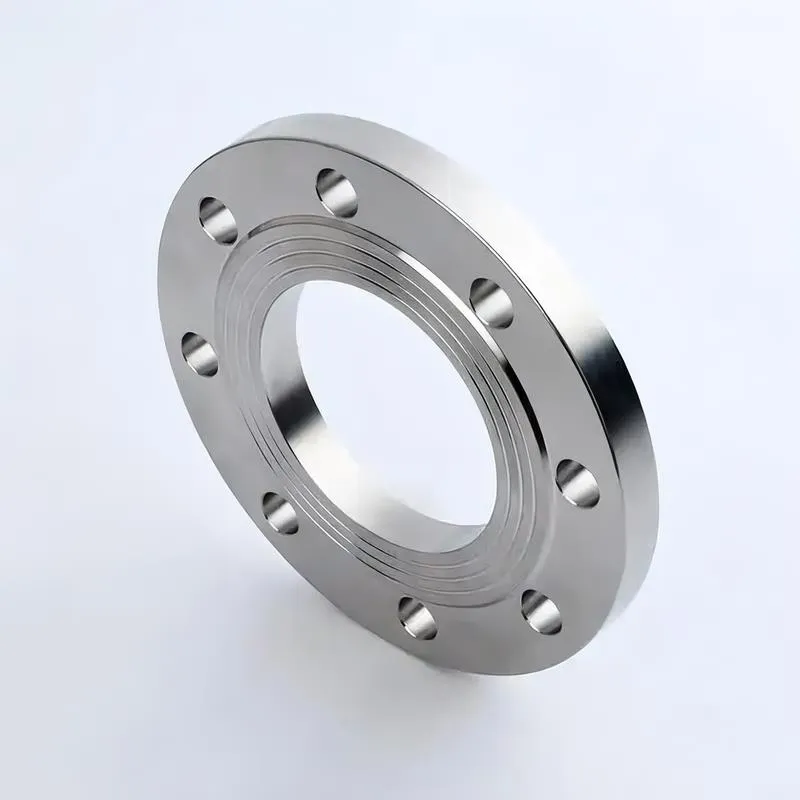
A flange—also referred to as a flange plate or rim—is a component used to connect shafts to one another, or, more commonly, to join the ends of pipes. Flanges are also utilized at the inlet and outlet ports of equipment to facilitate connections between two devices—for instance, the flange on a speed reducer. A "flange connection" or "flanged joint" refers to a detachable joint assembly comprising three interconnected elements—a flange, a gasket, and bolts—that together form a sealed structural unit. In the context of piping systems, a "pipe flange" specifically denotes a flange used for plumbing within the installation; when applied to equipment, it refers to the inlet or outlet flange of that specific device. Flanges feature a series of holes through which bolts are inserted to securely fasten the two flanges together, while a gasket placed between the flanges ensures a leak-proof seal. Flanges are broadly categorized into three types: threaded (screw-in) flanges, welded flanges, and clamp-type flanges. Flanges are invariably used in pairs; threaded flanges are suitable for low-pressure piping applications, whereas welded flanges are required for systems operating at pressures exceeding 4 kilograms per square centimeter. A sealing gasket is inserted between the two flange plates, which are then firmly secured using bolts. The thickness of a flange—as well as the specifications of the bolts used to fasten it—vary depending on the specific pressure rating required for the application. When connecting equipment such as water pumps or valves to piping systems, the corresponding connection points on these devices are often manufactured in the shape of a matching flange; this method of attachment is also referred to as a "flange connection." Generally, any connecting component that utilizes bolts to join and seal the perimeters of two flat surfaces—such as the joints in ventilation ducts—is termed a "flange"; such components may collectively be classified as "flange-type parts." However, since such a connection often constitutes merely a *portion* of a larger device—for instance, the interface between a flange and a water pump—it would be inappropriate to classify the entire water pump itself as a "flange-type part." Conversely, smaller components—such as valves—that feature such flanged interfaces may indeed be appropriately categorized as "flange-type parts."
-:-
For detailed product information, please contact sales.
-:
AISI 4161H Steel Flange Product Information
-:-
For detailed product information, please contact sales.
-:
AISI 4161H Steel Flange Synonyms
-:-
For detailed product information, please contact sales.
-:
AISI 4161H Steel Product Information
-:-
For detailed product information, please contact sales.
-:
# **AISI 4161H Steel - Ultra-Hardenability Controlled Specialty Steel**
## **1. Product Overview & Technical Significance**
**AISI 4161H** represents an **extremely rare and specialized variant** of the 41xx series, combining **exceptional hardenability characteristics** with the **guaranteed consistency** of the "H" (hardenability-controlled) designation. This material sits at the intersection of ultra-high-carbon alloy steel and hardenability-controlled manufacturing philosophy, engineered for applications where both **maximum achievable hardness** and **predictable heat treatment response** are absolutely critical.
**Key Technical Distinctions:**
- **Historical Rarity:** One of the least commonly produced H-grades in the AISI/SAE system
- **Ultimate Hardenability:** Possibly the highest hardenability in the entire 41xx H-steel family
- **Boundary Material:** Bridges the gap between high-carbon alloy steels and low-alloy tool steels
- **Specialist Application:** Reserved for components where failure from heat treatment inconsistency is unacceptable
**Manufacturing Status:** Essentially a "special order only" material produced by a limited number of specialty steel mills for specific, well-defined applications.
## **2. International Standards & Designations**
| Region/Standard | Designation | Status & Availability |
|-----------------|-------------|------------------------|
| **United States** | AISI 4161H, SAE 4161H | Historical SAE specification; theoretically compliant with ASTM A304 |
| **UNS Designation** | H41610 | Assigned but virtually never used commercially |
| **Europe** | No equivalent | Potential custom designation: 55CrMo6H with Mn adjustment |
| **Japan** | No equivalent | Potential: Special SCM445H ultra-high Mn variant |
| **China** | No equivalent | Would require custom steelmaking |
| **ISO** | No equivalent | - |
| **Practical Reality** | Customer proprietary specification | Typically supplied to exact customer requirements |
**Critical Standard Reference (Theoretical):**
- **ASTM A304:** Standard Specification for Carbon and Alloy Steel Bars Subject to End-Quench Hardenability Requirements
- **Note:** While 4161H would theoretically comply with ASTM A304, actual production would require special agreement between customer and producer.
## **3. Chemical Composition (Weight %)**
*Based on extrapolation from SAE 4161 composition with H-steel philosophy*
| Element | Theoretical H-Steel Range (%) | SAE 4161 Base Range (%) | H-Steel Manufacturing Logic |
|---------|-------------------------------|-------------------------|----------------------------|
| **Carbon (C)** | 0.54 - 0.66 | 0.56 - 0.64 | Widest range to allow hardenability tuning while maintaining ultra-high carbon |
| **Manganese (Mn)** | 0.95 - 1.35 | 1.00 - 1.30 | **Critical:** Key hardenability element; range extended for H-steel flexibility |
| **Phosphorus (P)** | ≤ 0.020 | ≤ 0.035 | Ultra-low maximum for H-grade to minimize embrittlement |
| **Sulfur (S)** | ≤ 0.020 | ≤ 0.040 | Controlled for consistent machinability and transverse properties |
| **Silicon (Si)** | 0.15 - 0.35 | 0.15 - 0.35 | Standard range maintained |
| **Chromium (Cr)** | 0.65 - 0.95 | 0.70 - 0.90 | Wider range to accommodate hardenability adjustment with high Mn |
| **Molybdenum (Mo)** | 0.15 - 0.25 | 0.15 - 0.25 | Critical for temper embrittlement resistance |
| **Boron (B)*** | 0.001 - 0.005 | Not specified | Likely included to maximize hardenability efficiency |
**H-Steel Manufacturing Philosophy for 4161H:**
```
Production Example:
- Heat A: C=0.58%, Mn=1.25%, Cr=0.70%
- Heat B: C=0.62%, Mn=1.05%, Cr=0.85%
- Heat C: C=0.60%, Mn=1.15%, Cr=0.80%, B=0.003%
- RESULT: All three heats produce IDENTICAL Jominy hardenability curves
```
## **4. Hardenability Characteristics - Extreme Performance**
*Theoretical Jominy bands for this ultra-high hardenability steel*
### **ASTM A304 Hardenability Bands (Estimated)**
*Assuming production to highest possible bands (e.g., Band 7-9)*
| Distance (1/16") | Band 7 (HRC) | Band 8 (HRC) | Band 9 (HRC) | Technical Significance |
|------------------|--------------|--------------|--------------|------------------------|
| **J₁ (Surface)** | 62 - 66 | 63 - 67 | 64 - 67 | Approaches theoretical maximum hardness |
| **J₄** | 58 - 62 | 59 - 63 | 60 - 64 | Exceptional shallow hardening |
| **J₈** | 54 - 58 | 55 - 59 | 56 - 60 | Center of 2-inch bar would be this hard |
| **J₁₂** | 50 - 54 | 51 - 55 | 52 - 56 | Center of 3-inch bar capability |
| **J₂₀** | 46 - 50 | 47 - 51 | 48 - 52 | Center of 5-inch bar capability |
| **J₂₈** | 42 - 46 | 43 - 47 | 44 - 48 | **Unprecedented** depth of hardening |
### **Hardenability Performance Metrics**
| Parameter | Estimated Value | Industry Comparison |
|-----------|----------------|-------------------|
| **Ideal Critical Diameter (Dᵢ)** | 180-220 mm (7-9 inches) | Possibly highest in Cr-Mo series |
| **95% Martensite Diameter (D₉₅)** | 150-180 mm (6-7 inches) | Exceptional |
| **Grossmann Hardenability Factor** | 8.0-9.0+ | Top of scale for alloy steels |
| **Quench Severity Required** | Low (H=0.25-0.35) | Can harden in slow oil or even air for small sections |
| **Maximum Effective Diameter** | 250+ mm (10+ inches) | For useful hardening |
## **5. Physical Properties (Estimated)**
*Based on high-carbon, high-manganese alloy steel behavior*
| Property | Estimated Value | Technical Basis |
|----------|----------------|-----------------|
| **Density** | 7.84-7.85 g/cm³ | Slightly lower due to high Mn |
| **Melting Range** | 1375-1465°C | Lower due to high C and Mn |
| **Modulus of Elasticity (E)** | 200-205 GPa | Slightly reduced by high alloy content |
| **Shear Modulus (G)** | 78-80 GPa | - |
| **Poisson's Ratio (ν)** | 0.29-0.30 | - |
| **Thermal Conductivity** | 37.5-39.5 W/m·K | Reduced by alloy elements |
| **Specific Heat Capacity** | 465-485 J/kg·K | - |
| **Thermal Expansion** | 12.5 × 10⁻⁶ /K | 20-100°C |
| **Electrical Resistivity** | 0.28-0.32 µΩ·m | High due to alloy content |
| **Magnetic Transition** | Ferromagnetic | Below Curie temperature (~770°C) |
## **6. Mechanical Properties by Condition**
### **As-Annealed Condition**
| Property | Estimated Range | Characteristics |
|----------|----------------|-----------------|
| **Hardness** | 269-321 HB | Very high for annealed condition |
| **Tensile Strength** | 965-1138 MPa | Exceptional for annealed state |
| **Yield Strength** | 690-860 MPa | - |
| **Elongation** | 10-16% | Limited due to high carbon |
| **Reduction of Area** | 30-40% | - |
| **Machinability** | 25-30% of B1112 | Extremely difficult |
### **Quenched & Tempered Performance**
*After proper heat treatment*
| Tempering Temperature | Hardness (HRC) | Tensile Strength | Charpy Impact | Primary Limitation |
|-----------------------|----------------|------------------|---------------|-------------------|
| **150°C (300°F)** | 63-65 | 2000-2200 MPa | 5-10 J | Extreme brittleness |
| **205°C (400°F)** | 60-63 | 1930-2070 MPa | 7-14 J | Very low toughness |
| **315°C (600°F)** | 56-59 | 1795-1930 MPa | 10-20 J | Limited applications |
| **425°C (800°F)** | 50-54 | 1590-1725 MPa | 14-27 J | Practical upper limit for many uses |
| **540°C (1000°F)** | 44-48 | 1380-1520 MPa | 20-34 J | Better toughness balance |
| **595°C (1100°F)** | 38-42 | 1240-1380 MPa | 27-41 J | Maximum useful toughness |
## **7. Heat Treatment Protocol for 4161H**
### **Critical Processing Requirements**
```
UNIQUE HEAT TREATMENT CHALLENGES FOR 4161H:
1. AUSTENITIZING TEMPERATURE: 790-810°C (1455-1490°F)
- Must be tightly controlled (±5°C)
- Lower than standard 41xx due to high C and Mn
- Higher risk of retained austenite if too high
2. QUENCHING PRECAUTIONS:
- Oil quench sufficient even for large sections
- Polymer quenchants recommended for complex shapes
- Water or brine quench PROHIBITED (certain cracking)
- Quench delay <2 seconds critical
3. TEMPERING REQUIREMENTS:
- DOUBLE tempering MANDATORY
- Minimum tempering temperature: 150°C (300°F)
- Interrupted quenching may be beneficial
- Cryogenic treatment may be required to eliminate retained austenite
```
### **Recommended Heat Treatment Sequence**
```
Step 1: PREHEAT (Critical)
Temperature: 650°C (1200°F) → 700°C (1290°F)
Time: 60+ minutes per inch
Purpose: Absolutely essential to prevent cracking
Step 2: AUSTENITIZE
Temperature: 800°C ±5°C (1475°F ±10°F)
Time: 30 minutes per inch minimum
Atmosphere: Protective with precise carbon potential control
Step 3: QUENCH
Medium: Fast oil (40-50°C) or polymer quenchant
Agitation: Vigorous, uniform
Temperature drop: Monitor continuously
Step 4: FIRST TEMPER (Immediate)
Temperature: 150-175°C (300-350°F)
Time: 2+ hours per inch
Purpose: Initial stress relief
Step 5: CRYOGENIC TREATMENT (Optional but Recommended)
Temperature: -80°C to -196°C (-112°F to -321°F)
Time: 1-2 hours
Purpose: Transform retained austenite
Step 6: SECOND TEMPER
Temperature: 10-20°C higher than first temper
Time: 2+ hours per inch
Cooling: Air cool to room temperature
Step 7: STRESS RELIEF (If Machined After Heat Treatment)
Temperature: 150°C (300°F)
Time: 2-4 hours
Purpose: Relieve machining stresses
```
## **8. Product Applications - Extreme Specialty Uses**
### **Defense & Aerospace (Classified Applications)**
- **Armor piercing core materials** (historical applications)
- **Missile guidance system components** requiring dimensional stability
- **Armor vehicle components** subject to extreme impact and wear
- **Aircraft carrier deck machinery** requiring guaranteed properties
- **Nuclear submarine components** (non-critical path)
### **Oil & Gas - Ultra-Deep & Extreme Environments**
- **Drill bits** for deepest hard rock formations (20,000+ feet)
- **Core barrel components** for scientific drilling
- **Blowout preventer shear rams** for deepest wells
- **Downhole logging tool components** requiring reliability
- **Subsea Christmas tree components** in high-pressure service
### **Power Generation - Critical Components**
- **Nuclear reactor control rod drive mechanisms** (secondary components)
- **Turbine blade roots** for largest steam turbines
- **Generator retaining rings** for largest units
- **High-pressure boiler components** in supercritical plants
- **Hydro turbine wear rings** for silt-laden water
### **Heavy Industry - Maximum Demanding Applications**
- **Cement kiln tire sections** for largest rotary kilns
- **Steel continuous caster rolls** for widest slabs
- **Mining shovel dipper teeth** for hardest rock
- **Crusher mantles** for primary gyratory crushers
- **Grinding mill liners** for largest SAG mills
### **Scientific & Research Applications**
- **Synchrotron radiation components** requiring dimensional stability
- **Particle accelerator components** with magnetic properties requirements
- **Cryogenic system components** requiring specific thermal properties
- **High-pressure research vessel components**
- **Reference standards** for hardness testing equipment
## **9. Manufacturing & Processing Challenges**
### **Machining Characteristics**
- **Annealed Condition:** 20-25% of B1112 (Extremely Difficult)
- **Normalized Condition:** 15-20% of B1112 (Near Impossible for Complex Parts)
- **Hardened Condition:** 5-10% of B1112 (Grinding Only)
- **Tool Requirements:** Premium CBN or ceramic tools only
- **Coolant:** High-pressure, high-volume essential
- **Recommendation:** Machine in softest possible condition, then heat treat
### **Welding Characteristics**
- **Rating:** Essentially Non-Weldable
- **If Absolutely Required:**
- Must be in fully annealed condition
- Preheat: 400-450°C (750-850°F)
- Post-Weld: Full re-heat treatment cycle
- Filler: Nickel-based superalloy fillers only
- Application: Emergency repair only, not for fabrication
### **Grinding & Finishing**
- **Grinding Method:** Creep-feed grinding recommended
- **Wheel Selection:** CBN or diamond wheels required
- **Coolant:** Essential to prevent thermal damage
- **Risk:** Extreme susceptibility to grinding burns and cracks
- **Finishing:** Electrochemical machining (ECM) or EDM may be preferred
## **10. Quality Assurance & Certification Requirements**
### **Mandatory Certification Package**
1. **ASTM A304 Compliance Certificate** (with actual Jominy curve)
2. **Statistical Process Control Data** for entire manufacturing process
3. **Full Traceability Documentation** from melt to finished product
4. **Metallurgical Analysis Report** including:
- Complete chemical analysis (including trace elements)
- Inclusion analysis (ASTM E45, Methods A & D)
- Grain size measurement (multiple methods)
- Prior austenite grain size
5. **Non-Destructive Testing Reports:**
- 100% ultrasonic testing
- 100% magnetic particle inspection
- Surface roughness mapping
### **Enhanced Testing Protocol**
- **Charpy V-Notch Transition Curve:** -100°C to +200°C
- **Fracture Toughness Testing:** K₁c, J₁c, CTOD
- **Fatigue Testing:** High-cycle and low-cycle
- **Residual Stress Analysis:** X-ray diffraction mapping
- **Microcleanliness:** Advanced inclusion analysis
- **Hardenability Verification:** Multiple Jominy tests from same heat
## **11. Comparison with Alternative Materials**
### **vs. Standard 4161**
| Parameter | AISI 4161H | Standard AISI 4161 | Advantage |
|-----------|------------|-------------------|-----------|
| **Hardenability Guarantee** | Certified bands | Variable | 4161H: Predictable results |
| **Consistency** | Statistical assurance | Lot-to-lot variation | 4161H: Process control |
| **Risk Management** | Low (controlled) | High (variable) | 4161H: Reduced failure risk |
| **Certification** | Full Jominy + SPC | Standard MTR only | 4161H: Higher confidence |
| **Cost** | 2-3× higher | Baseline | Standard: More economical |
| **Application** | Critical, regulated | General extreme use | Different risk profiles |
### **vs. Tool Steels with Similar Hardness**
| Material | AISI 4161H | AISI D2 Tool Steel | AISI S7 Shock Steel |
|----------|------------|-------------------|-------------------|
| **Carbon** | 0.54-0.66% | 1.40-1.60% | 0.45-0.55% |
| **Chromium** | 0.65-0.95% | 11.00-13.00% | 3.00-3.50% |
| **Hardenability** | Exceptional | Excellent | Good |
| **Toughness** | Very Low | Low | Very High |
| **Primary Use** | Large structural wear parts | Cold work tools | Impact tools |
| **Cost Relative** | 1.0× | 1.5-2.0× | 2.0-3.0× |
## **12. Design & Engineering Guidelines**
### **Design Principles for 4161H**
1. **Minimize Stress Concentrations:** All fillets R10 mm minimum
2. **Avoid Section Changes:** Gradual transitions only (1:6 ratio minimum)
3. **Design for Grinding:** Allow for finish grinding after heat treatment
4. **Consider Assembly:** Design for mechanical fastening, not welding
5. **Plan for Inspection:** Include NDE access in design
### **Failure Prevention Strategies**
1. **Stress Analysis:** FEA mandatory for all load-bearing components
2. **Fracture Mechanics:** Include in design for critical applications
3. **Redundancy:** Design with fail-safe principles
4. **Testing:** Prototype testing under actual service conditions
5. **Monitoring:** Include condition monitoring in service
## **13. Economic & Supply Considerations**
### **Supply Chain Reality**
- **Number of Producers:** 1-3 worldwide (specialty mills only)
- **Lead Time:** 6-12 months for new melt
- **Minimum Order:** 20,000-50,000 lbs typically
- **Cost Factor:** 3-5× standard 4140H
- **Availability:** Essentially "made to order" only
### **Total Cost of Ownership Analysis**
| Cost Component | 4161H Factor | Rationale |
|----------------|--------------|-----------|
| **Material Cost** | 3-5× baseline | Specialized melting and processing |
| **Certification Cost** | Significant | Extensive testing and documentation |
| **Machining Cost** | 2-3× normal | Premium tooling, slower speeds |
| **Heat Treatment Cost** | 1.5-2× normal | Specialized facilities, controlled processes |
| **Inspection Cost** | High | Extensive NDE requirements |
| **Failure Risk Cost** | Very Low | Predictable performance reduces risk |
| **Total Life Cycle Cost** | May be favorable | For applications where failure cost is extreme |
## **14. Technical Risk Assessment**
### **Primary Technical Risks**
1. **Quench Cracking:** High probability without exacting controls
2. **Brittle Fracture:** Likely if improperly designed or processed
3. **Grinding Damage:** High risk without proper techniques
4. **Dimensional Instability:** During heat treatment if not properly fixtured
5. **Supply Chain Disruption:** Single-source dependency risks
### **Risk Mitigation Strategies**
1. **Process Validation:** Statistical validation of all processes
2. **Redundant Testing:** Multiple test methods for critical properties
3. **Supplier Qualification:** Multiple qualified suppliers if possible
4. **Design Margin:** Conservative safety factors
5. **Life Testing:** Extended testing before full production
## **15. Future Outlook & Alternatives**
### **Modern Alternatives to Consider**
1. **Modified 4140/4150H:** With adjusted processing
2. **Proprietary High-Hardenability Grades:** From specialty steel producers
3. **PM (Powder Metallurgy) Tool Steels:** For better toughness at high hardness
4. **Managing Steels:** For better toughness and dimensional stability
5. **Custom Alloy Development:** Tailored to specific application needs
### **Industry Trends Impacting 4161H**
1. **Declining Use:** Due to processing challenges and alternatives
2. **Consolidation:** Fewer producers of such specialized materials
3. **Regulatory Pressure:** Increasing documentation requirements
4. **Cost Pressure:** Driving substitution with more economical alternatives
5. **Technical Evolution:** New materials offering better combinations of properties
---
## **Executive Summary: Strategic Application Framework**
### **When 4161H Might Be Justified**
```
Decision Criteria (ALL must be true):
1. Component requires >55 HRC hardness in sections >150 mm
2. Heat treatment consistency is safety-critical or has extreme economic consequences
3. No alternative material provides required combination of properties
4. Failure cost >> material and processing cost premium
5. Supply chain and processing capabilities exist and are qualified
```
### **Practical Implementation Checklist**
- [ ] Application truly justifies extreme material
- [ ] Qualified heat treatment facility available
- [ ] Machining capability exists for this difficult material
- [ ] Full testing and certification budget allocated
- [ ] Alternative materials thoroughly evaluated and rejected
- [ ] Life cycle cost analysis completed
- [ ] Supply chain risks assessed and mitigated
- [ ] Regulatory requirements understood and achievable
### **Competitive Material Analysis Decision Tree**
```
Start: Need extreme hardenability + hardness
│
├─→ If cost is primary constraint → Consider modified 4150 with special processing
│
├─→ If toughness is also needed → Consider premium tool steels or managing steels
│
├─→ If availability is critical → Choose more common grade with design adaptation
│
└─→ If ALL extreme requirements are absolute → ONLY THEN consider 4161H
```
---
**Final Assessment:** AISI 4161H represents perhaps the most extreme expression of the H-steel philosophy applied to the highest-carbon variant of the 41xx series. Its practical application in modern engineering is extraordinarily limited and should only be considered after exhaustive evaluation of alternatives. When properly applied to genuinely justified applications, it can provide unique performance capabilities, but the technical, economic, and supply chain challenges are substantial.
**Historical Perspective:** 4161H represents a specific historical solution to extreme hardenability requirements that emerged during the mid-20th century. Modern materials science often provides alternative solutions that may offer better overall performance characteristics for contemporary applications.
---
**Disclaimer:** This specification describes an extremely rare and specialized material. The information presented is based on historical data, metallurgical principles, and extrapolation from related grades. Actual properties, availability, and processing characteristics should be confirmed through direct consultation with capable specialty steel producers. This material should only be considered by organizations with extensive experience in advanced materials and heat treatment processing. Always consult with multiple materials engineering specialists before considering such specialized materials for any application.
-:-
For detailed product information, please contact sales.
-:
AISI 4161H Steel Specification
Dimensions
Size:
Diameter 20-1000 mm Length <4056 mm
Size:We can customized as required
Standard:
Per your request or drawing
We can customized as required
Properties(Theoretical)
Chemical Composition
-:-
For detailed product information, please contact sales.
-:
AISI 4161H Steel Properties
-:-
For detailed product information, please contact sales.
-:
Applications of AISI 4161H Steel Flange
-:-
For detailed product information, please contact sales.
-:
Chemical Identifiers AISI 4161H Steel Flange
-:-
For detailed product information, please contact sales.
-:
Packing of AISI 4161H Steel Flange
-:-
For detailed product information, please contact sales.
-:
Standard Packing:
-:-
For detailed product information, please contact sales.
-:
Typical bulk packaging includes palletized plastic 5 gallon/25 kg. pails, fiber and Steel Flange drums to 1 ton super sacks in full container (FCL) or truck load (T/L) quantities. Research and sample quantities and hygroscopic, oxidizing or other air sensitive materials may be packaged under argon or vacuum. Solutions are packaged in polypropylene, plastic or glass jars up to palletized 527 gallon liquid totes Special package is available on request. E FORUs’ is carefully handled to minimize damage during storage and transportation and to preserve the quality of our products in their original condition